Sunday, September 18, 2016

Amazing Grace


Today marks fifteen years since the terrorist attacks on September 11th 2001.  Where were you that day when you first heard the news? For myself I can vividly recall turning on the television to see images of smoke pouring out of the world trade center. The news anchors were speculating that perhaps, a small passenger plane flying too low had accidently crashed into the tower. They seemed very perplexed. I remember puzzling over it myself with my cousin who was visiting that morning, when suddenly right before our eyes the second plane hit. The horror of the following events unfolded before us as we watched in disbelief. The third plane went down over Pennsylvania. Perhaps most shocking of all, was the collapse of the massive towers.  I remember wondering if the attacks would continue throughout the day.

I was a young college student at the time. For myself and for others my age, it was the defining moment of our generation. Emerging as we were into the world of adulthood and responsibility, it was a painful and sobering confrontation with human nature and the desperate realities of the world. Nothing would ever be the same again. Our consciousness was forever altered.

Those events caused me to reflect, in a more serious way than ever before, on the seeming intractability of moral and social evil. How could I be a part of the healing of our broken world? Where was genuine hope to be found? The years ahead would involve me in a spiritual and intellectual search. I delved into works of psychology, philosophy, politics, and religion. It was a dizzying experience, and one that—at least initially stirred up more questions than answers. 

These periods of questioning and instability, however, have the potential to be turning points in our spiritual journey. I found that the experience brought me to a much deeper engagement with my Christian faith and a greater confidence in its truthfulness. I found in the gospel good news for the brokenness of the world and for the darkness in my own heart that I found nowhere else. It was a message that shifted my focus from programs for self-improvement and agendas for political revolution—who’s hope rested on the power and initiative of human beings—and  centered my hope on the more sturdy foundation of God. At the heart of the gospel is the beautiful and transformative proclamation of God’s grace.


What is grace anyway? It is usually defined as, “unmerited favor.” That is a good place to start. If we want to understand grace we first need to get our heads around the idea that it is a completely undeserved gift. If I give you something in exchange for a service rendered me, that is compensation. If a man sends flowers to a woman who’s beauty he admires, that is appreciation. But if I show mercy to someone who has wronged me, that is grace. It is a free choice of the giver of the gift, unconditioned by anything about the recipient.

Grace is perhaps better conveyed than defined. Its power is beautifully extolled with astonished wonder in a much loved hymn penned by John Newton,

Amazing Grace, how sweet the sound,
That saved a wretch like me....
I once was lost but now am found,
Was blind, but now, I see.

Newton was a former slave trader turned abolitionist. He was converted to Christ after being spared during a horrible storm at sea. The lyrics of the hymn capture his amazment at having received God’s grace in his unworthiness. They describe the change that understanding and receiving God’s grace produced in his life. 

In a similar way, in our Epistle reading this morning, Saint Paul recounts his own dramatic transformation. He was a, “blasphemer, a persecutor, and a man of violence,” yet God showed grace to him and called him to be an apostle of the Gospel. He goes so far as to say that God chose him, the chief of sinners, in order to make him an example of his amazing grace.


It was this grace that became the constant theme of his preaching. Saint Paul writes in his Epistle to the Romans,

“Christ died for the ungodly. It is rare indeed for anyone to die for a righteous man, though for a good man someone might possibly dare to die. But God proves His love for us in this: While we were still sinners, Christ died for us.…”

How is it that this message of God’s grace can change the world?

First, God’s grace means that there is hope for the future. God has not rejected us or treated us according to our sins, but instead he has reconciled the world to himself through his Son Jesus Christ. The Gospel is his declaration of peace with the human race. The whole reason Jesus came into the world was not to condemn the world, but to seek and save lost sinners, rebels who had spurned his father’s love and wandered far from him. In Christ, God has paid the moral debt amassed against us and has borne the penalty for our sin. He has declared us free and forgiven. More than that, to those who believe in him, he has promised to give the power to live righteously, to live transformed lives. 

Those who have heard and believed the message of God’s grace and mercy in Jesus Christ, have often spoken of being “born again.” They testify to being a new creation, a whole new person. They have a new meaning and a purpose for life. Changed hearts and lives mean a changed world.


Secondly, God’s grace makes us children of God through Christ. God is our loving Father who loves us all unconditionally. If God is our Father it means that—whether they are a believer or not, whether they are from the same country as us or another, whether they agree with us politically or not, whether or not that they live their lives in a way that we approve—every human being is our brother or sister.

 We cannot be indifferent to them because they are our own flesh and blood. God has equal love for all his children, and we cannot claim to have a place superior to our brothers and sisters. We all stand shoulder to shoulder as recipients of God’s grace, as those for whom Christ died, as rebels who have been made sons and daughters.  If we accept the Gospel, we know that to love God we also must love of neighbor.

Finally, God’s grace to us moves us to show mercy and compassion to others. Perhaps the most revolutionary of Jesus’ ethical demands is the call to love our enemies. This teaching is the natural consequence of God’s grace. If God has shown us such mercy in forgiving us and laying down his life for us, we should endeavor to show the same grace to our own enemies. Grace breaks the never ending spiral of violence. It does more than vanquish our enemies, rather through the appeal of love it has the power to make them our allies in the Kingdom of God.

It seems like every week we hear of some terrible new tragedy, the latest terrorist attack or natural disaster. Each heart rending event only confirms to us more, we need God’s Grace. We need his forgiveness for our unforgiveness and for the terrible things we do to one another. We need his hope amidst the despair we sometimes feel. We need his strength and guidance as we seek to mend our wounded world. Thankfully, God’s grace is abundant. It is a never ending stream of goodness poured out on us his wandering children. 

Wednesday, September 7, 2016

Runaway Slave


Philemon 1-21


Frederick Douglas was a runaway slave. From those humble beginnings he went on to become one of the most influential statesman, orators, authors, and social reformers of his generation, all this during a time in our country when African-Americans were still not free. He was a remarkable man, and his story is powerfully laid out for us in his gripping autobiography, The Narrative and Life of Frederick Douglas, An American Slave  as well as his second book, My Bondage and My Freedom.

Frederick Douglas was also a Christian. He was converted at an evangelical revival. He was captivated by the vision of freedom and liberation contained in the pages of Holy Scripture, and in the person and radical teaching of Christ the savior of the human race. Douglas had every reason to reject the Christian faith. He saw more than most the cruelty and hypocrisy of those who profess to be Christians. He writes,

I have seen my master tie up a lame young woman and whip her upon her naked shoulders, causing the warm red blood to drip. And in justification of the bloody deed, he would quote this passage of Scripture. "He that knoweth his master's will, and doeth it not, shall be beaten with many stripes."

He breathed out prophetic fire against such wicked distortions of the gospel,
“between the Christianity of this land, and the Christianity of Christ, I recognize the widest possible difference–so wide, that to receive the one as good, pure, and holy, is of necessity to reject the other as bad, corrupt, and wicked. To be the friend of the one, is of necessity to be the enemy of the other. I love the pure, peaceable, and impartial Christianity of Christ: I therefore hate the corrupt, slaveholding, women-whipping, cradle-plundering, partial and hypocritical Christianity of this land. Indeed, I can see no reason, but the most deceitful one, for calling the religion of this land Christianity. I look upon it as the climax of all misnomers, the boldest of all frauds, and the grossest of all libels.”

Douglas was at the center of a growing movement among Christians to abolish the practice of slavery in the United States.  The controversy stirred by “abolistionist”—as  they were called—divided many of the protestant churches in two. The fault lines tended to run between the north and south of the country. The issue was more than just an ecclesiastical squabble, but a deep cultural divide. Both sides had passionate commitments to the Christian faith and both sides insisted that the Bible championed their cause. At the heart of the debate was tiny Epistle of Philemon, which at a mere 335 words is among the shortest books in Holy Scripture. Indeed our Epistle reading today contains the book in nearly its entirety.

The letter concerns a man named Onesimus, who like Frederick Douglas, was an escaped slave. He has run away from his master Philemon, a wealthy Christian of Paul’s acquaintance, who hosts a congregation of Christians in his home. This Onesimus, had not only run from Philemon’s service but it is also implied that he robbed him.

The runaway ended up in prison where he came under the teaching and the influence of Saint Paul, and was converted to the faith. Paul is writing his letter from prison and he means that it should accompany Onesimus on his return to Philemon as a kind of recommendation. He asks that Philemon would not punish Onesimus for his treachery but that he receive him, “no longer as a slave, but better than a slave, as a dear brother.”

Interpreters have differed widely on how Paul’s letter should be understood.
One defender of slavery, Augustus Longstreet wrote, 
It appears plain to me why this epistle has been preserved. It is that men may see that it is possible to hold slaves and go to heaven.” 

Another, Theodore Clapp, said,

“[Saint Paul] entreats Philemon not to punish Onesimus with severity, but to treat him in the future as a reformed and faithful slave…Paul did not suggest to Philemon the duty  of emancipating Onesimus, but encouraged him to restore the slave to his former condition, with the hope that, acting under the holy principles of Christianity, he would in future serve his master, ‘not with eye service,’ as formerly, ‘but in singleness of heart, fearing God.”

It must be said that even for Paul merely to suggest that Philemon forgive Onesimus and not punish him was a radical suggestion that undermined the cultural institution of slavery. In Roman culture, a runaway slave was entirely subhuman. To desert one’s household was unforgivable and worthly of death by crucifixion or at the very least severe beating and branding. Paul not only instructs Philemon not to punish him but suggest instead that he be embraced as a brother and as if he were Saint Paul’s very own son.

Abolistionist readers of this text insisted that it needed to read in light of the freedom and equality of all the saints in Christ. We must not forget Paul’s words from Galatians, “There is neither Jew nor Greek, there is neither slave nor free man, there is neither male nor female; for you are all one in Christ Jesus.”

It is true that Paul, elsewhere instructs slaves to submit to their masters, “as to Christ” (Ephesians 6:5-9). He gives the same instruction to women in regards to their husbands that they should submit to them, “as to the Lord.” In both cases however, the more surprising instruction of Paul to husbands to lay down their lives for their wives and to masters to regard those under their authority as their equal, is too often ignored.

Regardless of where our rank in society is, we are to mutually “submit to one another in love.” There is all the difference in the world between the loving submission of equals and tyranny of the powerful over the weak. Masters are to relinquish any thought of superiority over their slaves and to, “give up threatening, knowing that both their Master and yours is in heaven, and there is no partiality with Him.”

There can be no coercion between brothers and equals. Paul models for Philemon a leadership that makes its appeal through love, “Accordingly, though I am bold enough in Christ to command you to do what is required, yet for love’s sake I prefer to appeal to you” (1:8-9).

Apologist for slavery often pointed out how Paul makes no command that Philemon free his slave, and this is true. Instead on the basis of the love that he knows Philemon has for him and, “for all the Saints,” he appeals to him to do what he knows is right. He is confident that Philemon, “will do even more than I say.” He even not so subtly lays a guilt trip on him, “I say nothing about your owing me even your own self.”

What is it that Paul is beating around the bush, suggesting that Philemon do? He says, “I wanted to keep him [Onesimus] with me, so that he might be of service to me in your place during my imprisonment for the gospel; but I preferred to do nothing without your consent, in order that your good deed might be voluntary and not something forced.”

His implication is clear, Onesimus should be set at liberty so he can return to serve Paul, not as a runaway slave and fugitive, but as a free man at the blessing of his master!

What became of Onesimus? We know that Saint Paul made him with Tychicus, the bearer of his Epistle to the Colossians (Col. 4:7-9) which suggests that Philemon did set him free. Ignatius, writing around the year 110AD, refers to a Bishop in Ephesus of the same name. Saint Jerome and other Church Fathers suggest that he was the same man as the former slave of Philemon. Bishop Onesimus suffered Martyrdom for the faith. 

Perhaps you are thinking that Paul should have been more direct with Philemon? It is easy for us to see—from where we are today—with the moral clarity on slavery that progress brings, but we stand on the shoulders of these small beginnings.  Although Paul does not directly condemn the institution of slavery, he pulled the pin on a grenade and set it rolling.

In Jesus’ time the disciples were impatient for change and asked him, “Lord, will you at this time restore the kingdom to Israel?” They imagined the immediate overthrow of the powers that be, a revolutionary regime change in which Ceasar would be deposed and Christ enthroned as King, but Jesus’ Kingdom revolution was of a different sort. It was a revolution of hearts and minds.  It is a revolution that makes its appeal through love rather than coercion. He said it was leaven working invisibly, gradually, and subtly through a lump of dough.

The Gospel sowed the seeds for the abolition of slavery, it sowed the seeds also for the liberation of women, which eventually grew into the movements of freedom and liberation of the modern world.  Some victories are slower than others. Indeed we have only scratched the surface in understanding the full implications of the Gospel. The cost of discipleship has always been too high. G.K. Chesterton said, 

“Christianity has not been tried and found wanting, it has been found difficult and left untried.” 
Between our halting attempts, and the Christianity of Christ, there is yet the widest possible difference. 

Monday, August 29, 2016

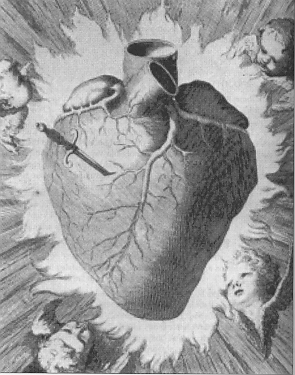
The Heart of the Matter.

https://web.stanford.edu/class/history13/earlysciencelab/body/heartpages/sinsheart.gif

Luke 14:1, 7-14


Plans are already underway for my Institution and Induction as the nineteenth rector of Saint George’s Church on October 28th the Feast of Saints Simon and Jude. There will be a special mass presided over by the Bishop where I will officially and formally be given charge over this parish. It is really quite an honor. Our wardens are also planning a reception to follow in the Great Hall. It sounds like it will be a joyous and grand affair.

Just this week I began sending out notices to friends, family, and colleagues to join me for this very special occasion. I hope you all will be there as well. According to our Gospel Lesson today, however, it looks like we might be going about this all in the wrong way! While at a party Jesus tells his host, "When you give a dinner, do not invite your friends or your brothers or your relatives or rich neighbors, but instead invite the poor, the crippled, the lame, and the blind.”

What a very odd thing to say! It’s a miracle that Jesus got invited to any parties at all when he was going around saying things like that! Taken literally, it is a completely offensive and ridiculous suggestion. Showing hospitality to the poor and needy is of course a fine thing to do, but I think that we can agree that inviting your mother to a dinner party isn’t a bad thing either. So what do we do with scripture like this? Do we simply marvel at how radical and eccentric Jesus was and move on?  No, Jesus’ provocative rhetoric is an invitation to dig deeper.

A consistent theme of Jesus’ teaching is the need to go beyond mere external conformity to the law towards genuine transformation of the heart. So for instance in the Sermon on the Mount he says,

“You have heard that it was said to the people long ago, ‘You shall not murder, and anyone who murders will be subject to judgment.’ But I tell you that anyone who is angry with a brother or sister will be subject to judgment.”

He also says, “You have heard that it was said, ‘You shall not commit adultery.’ But I tell you that anyone who looks at a woman lustfully has already committed adultery with her in his heart.”

In both cases he is saying, “It is not enough not to break the law. It is what is in your heart that matters.” He laments that the religious leaders of his day are like, “White washed tombs.” Outwardly they are clean and pure, but inside they are, “full of dead man’s bones.”

The Pharisees were unusually scrupulous in their ability to keep the letter of the law. They had every appearance of purity and righteousness. Yet a person’s behavior can be deceptive; it can be a mere appearance. A person can put on a good show. They can say and do all the right things, but who are they really? Jesus is not concerned with our persona—the image we project for the world to see—once again, it is the heart that concerns him.

The heart is the residence of our true self. It represents the core of who we really are. It is the seat of our will, and the source of all our actions. This is the part of us that matters the most. If we were half as concerned with our hearts as we are with our appearance, our reputation, or our material condition, we would be much better off spiritually!

When Jesus tells us not to invite our family or friends to our party, he isn’t giving us one more rule for holy living—if only it were that easy!—instead he is challenging us to examine our internal motivations. Are we inviting our friends, family, and—more pointedly—our rich neighbors because we hope for some personal gain? After all, they might return the favor and invite us to one of their parties. Those who instead invite those who have no chance of paying them back, show the purity of their motives. They may not receive an earthly reward but they will instead be repaid at the resurrection of the righteous.

The righteous seek God above all things, and so they look for the reward that comes from him rather than from human beings. Moreover they are content with whatever it is that God gives to them, rather than always grasping for position and honor.

This is illustrated in Jesus’ earlier discourse on humility. In Jesus’ culture, the table at a meal would typically be shaped like a U with the host sitting at the base. The seats of honor were those closest to the host. 

Jesus was a people watcher. He was always observing the behavior of those around him. Jesus is the expert on human nature, more so than even the most accomplished psychologist among us. He saw deeper than anyone else. What he saw that day was the way in which the guests were eager to sit at the place of greatest honor.  He saw beyond the appearances to their hearts.

The most honored guests at a feast were usually fashionably late. They knew that everyone was waiting for their arrival and they wanted to make a grand entrance. Jesus sees this as a teaching opportunity. “When you go to a party,” he says, “Don’t take the most honored seat. Someone more important might arrive and you will be embarrassed to find yourself getting pushed to the back. If you take the backseat, however, it is possible that the host might invite you to come up higher and you will be publicly honored. He tells them that those who humble themselves will be exalted.

Jesus’ teaching here is not merely a cunning way to receive honor nor is it a simple formula for how to be humble. If we take it in that way we will have missed the point entirely. Genuine humility is not about sitting in the worse seat, or wearing drab clothes, or being self deprecating in our speech. In fact being obsessively down on ourselves is just the other side of the coin from inflated self-regard. We must look away from ourselves and turn towards God. As C.S. Lewis wrote, “True humility is not thinking less of yourself; it is thinking of yourself less.”

It is the tyranny of self that is the greatest obstacle to authentic righteousness. As our reading from Sirach says, “The beginning of human pride is to forsake the Lord; the heart has withdrawn from its Maker.”

In our pride we have withdrawn our heart from seeking God, from being satisfied in him, and instead we are bent in on ourselves like a snake swallowing its own tail. We are devouring ourselves with our own self-seeking.

 The righteousness that Jesus looks for in us is much more about who we are than what we do. If we have a good heart than good works will naturally follow, but if our heart is wicked than even our good deeds are rotten. They do us more harm than good because they only serve to tighten the grip of selfishness and pride on us. We begin to be puffed up with a sense of our own righteousness. All attempts to rescue ourselves from this situation are futile. Instead we must depend wholly on the grace of God in Christ.


Only he can make us new. Only he can change our heart. We must learn from him who is humble and meek. When we begin to truly understand his love and grace for us, only then is our heart gradually weaned from the love of self and captivated by the love of God.

 We are the ones who are the crippled, the blind, and the lame who have nothing to offer but have been called to the feast. To all who acknowledge that they have no right to take the seat of honor he calls, “Come up higher!”


Set Free on the Sabbath


Luke 13:10-17

  One of my favorite things about my new home in the Stockade is the Riverside Park. My back yard opens right on to it. It has become a bit of an evening ritual of mine to take a walk down there after dinner. The river looks especially beautiful as the sun is setting. Sometimes I will just sit on the bench and watch the boats go by.  It has been a wonderful way to unwind at the end of the day. 

Where is it that you go for rest and restoration? Maybe you enjoy gardening, hunting, or fishing. Perhaps you have a cabin by the lake that you like to vacation at.  Maybe it is music that lifts your spirits, reading a novel, or just spending quality time with your family. Too often in our work-obsessed culture, such activities are dismissed as idleness, but God blesses and honors these times as part of the necessary rhythm of life.  

God has woven rest and renewal into the very fabric of creation. 
He has set limits on the activity of his creatures. We must rest and recuperate.  Our physical and mental make-up testifies to this.  Just as the sun goes down every evening and rises up again like a new creation every morning, so we too must lay down to rise up again refreshed and recreated each day.

In the Old Covenant God commanded that the seventh day be kept as a Sabbath to the Lord. No work was to be done on that day. The fourth commandment says, “Remember the Sabbath Day and keep it holy.” It was a day of rest and worship. God wanted his people to remember their limitations. He wanted them to remember that he was their creator and they were his creations. 

In our rebellion and estrangement from God we forget that basic fact. We put other things in the place of God—such as work, making money, or earning the approval of others—and we become servants of these gods. We become their prisoners. The commandment that God’s people observe the Sabbath, was meant to instruct them against this tendency.

Why then is it that we—as Christians—do not observe the Sabbath in the same way that God’s people in the Old Testament did or as our Jewish friends still do? More troubling still, why does it seem like Jesus is always going out of his way to break his people’s traditions around the observance of Sabbath? For instance In this morning gospel lesson Jesus is called out for healing on the Sabbath. Can God’s law change such that a thing can be wrong at one time and right at another?

It is important to remember that not all the laws in the Bible are the same. There are moral laws, civil laws, and ceremonial laws

Moral laws are the kind of laws that are universal and never change. They are natural laws that everyone in all times and places are beholden to. For instance the commandment against murder or adultery, will always be valid. 

Civil laws are the laws of the land. They are the legal prohibitions and penalties of the government. They are therefore specific to a particular context and not universal or changeless. Sometimes these overlap with moral laws, such as with the prohibition against murder, but they don’t need to. Traffic laws are a good example of civil laws in our context. To get caught running a red light doesn’t necessarily make you immoral but it does make you an offender against civil law. The civil laws described in the Old Testament do not apply to us. They are specific to that particular kingdom.
Ceremonial laws include specific regulations on how God’s people should properly perform the liturgy or how they should remain ritually clean. So for instance the prohibition against pork or shell fish in the Bible would fall under this category. These ceremonial laws too are not universal but specific to the old covenant. Christians believe that since Jesus brought the Old Covenant to a completion, fulfilling the purposes for which it was instituted, these laws no long apply to us. This is why Christians are permitted to eat any food they like and do not need to make animal sacrifices for sin. Jesus has atoned for sin once and for all through his own perfect sacrifice. 

The question is, what kind of law is the Sabbath Commandment? Is it a moral law, a civil law, or ceremonial? Various Christian communities have different beliefs regarding the Sabbath. Some, such as the Seventh-Day Adventist, actually observe Saturday as the Sabbath and worship on that day. Others apply the Old Testament restrictions against work on the Sabbath to Sunday. This question was a big source of controversy between Anglicans and Puritans in England. The Puritans regarded the Sabbath as a moral law. They banned all work on the Lord’s day, but also recreations and diversions like games or sports. 
However, in the Anglican tradition, of which the Episcopal Church is a part, the Old Testament Sabbath laws have usually been understood to be part of the ceremonial law that no longer applies to Christians.  

Jesus clearly regarded the Sabbath as part of the ceremonial laws. He compared it with the rituals and sacrifices of the temple and with circumcision. Jesus had very strict standards regarding the moral laws, more so than the Pharisees, yet when it came to the ceremonial laws he was much more lenient. Strikingly, Jesus is not recorded as giving any prohibitions regarding the Sabbath. Quite the opposite, he continually broke those restrictions. 

It wasn’t as if Jesus merely abolished the ceremonial laws. Jesus said, "Do not think that I have come to abolish the Law or the Prophets; I have not come to abolish them but to fulfill them.” These laws were established by God for a reason. The laws of the Old Covenant were meant to point forward and prepare the way towards their completion in the New Covenant. 


How is this illustrated in our Gospel lesson this morning? Jesus intentionally performs an act of healing and deliverance on the Sabbath in order to make a point. He was demonstrating the true meaning and purpose behind the Sabbath laws. Remember how we said that the Sabbath was meant to remind God’s people that time, business, productivity, and profit were not their masters? It was a day to be still and know that God was the Lord. The Sabbath is about freedom and not bondage, yet in their misplaced zeal the Pharisees had made it a heavy yoke, a burden that deprived God’s people of joy and liberty rather than restoring it. 

Jesus wants us to know the New Covenant of the Spirit—in which we will discover the true meaning of Sabbath—not the dead letter of the law which makes us less free rather than more free. 

Jesus said, “You hypocrites! Does not each of you on the Sabbath untie his ox or his donkey from the manger, and lead it away to give it water? And ought not this woman, a daughter of Abraham whom Satan bound for eighteen long years, be set free from this bondage on the Sabbath day?” The Sabbath day of all days is the day in which it is most appropriate to liberate those who are oppressed and in bondage. 

There is something more that needs to be said. In the Christian tradition Holy Saturday, the day between Good Friday and Easter, is called the Great Sabbath. It is the day when Jesus rested in the tomb. It is the day when all creation holds its breath in anticipation of the new creation of the glorious resurrection. It is also the day when Jesus descended to the realm of the dead to set at liberty those who were captives there. The Great Sabbath is a day of rescue, where God’s people are restored, and set free for new life. 

How did Jesus fulfill the purposes of God’s Sabbath Day? He set us free, he broke the bonds of sin and death, and made all things new. The scriptures say, if anyone is in Christ they are a new creation! This is why we worship on Sunday and not on Saturday. We are no longer waiting for the new creation. We are living in it! On Sundays we give thanks that Christ has set us free through his life, death, and resurrection.

 He has taken us who are bent over and oppressed, unable to stand, and he has made us to rise with him. Lift up your hearts! 

Sunday, August 14, 2016

A Wise Master-Builder


It is my privilege to be invited to address you all this morning. I must confess that the task of giving a homily addressed to members of a Masonic lodge is a challenging one. I am not myself a Free Mason, and my knowledge of the craft is elementary, but what I do know about masonry, I find rather fascinating.


Masonry seeks to preserve the mysteries passed on by the ancient guilds of masons. The ancients seemed to understand something about architecture that we—with all of our modern sophistication—do not. Historians still scratch their heads over how ancient architectural wonders, such as the Great Pyramids, were constructed. We have no written record. It was an era prior to the printing press where information was passed on largely verbally from master to apprentice. The signs and symbols of this craft are universal and appear throughout the ancient world in Egypt, Greece, Jerusalem, Rome, and throughout Europe. Those same architectural traditions have also influenced many of the great structures of our own nation. Their influence is even detected among the ancient civilizations south of our border.


The modern practice of Freemasonry is less concerned with the practical task of architecture than the speculative side of the craft. These principles and symbols come to us from the ancient past, from an age prior to the modern separation of the arts and sciences from the religious and spiritual pursuits of mankind. There was an esoteric as well as an exoteric dimension to masonry. In other words, there was an inner meaning to the outward forms constructed by ancient architects that was intended to inform and promote the spiritual and moral development of mankind. It was understood that things here below corresponded to things above in the heavens, the spiritual world.

Perhaps no other ancient structure has captivated the hearts and minds of people more than the Holy Temple in Jerusalem, built by King Solomon, in which scripture tells us the very presence of God tabernacled among us. The author of Hebrews tells us that the sanctuary of that temple, “was a copy and shadow of the heavenly sanctuary.” It was truly one of the great wonders of the ancient world. Its majesty and splendor is legendary.


In constructing this great structure, King Solomon invited the expertise of a great master of the craft, a man from Tyre, the son of a widow of the tribe of Naphtali. His name was Hiram. The scriptures tell us he was full of “skill, intelligence, and knowledge” or as the King James renders it, “wisdom, understanding, and cunning.”


The author of Kings gives us elaborate descriptions of Hiram’s work and the architectural detail of the Temple. These are of more than historical or antiquarian interest, but are meant to communicate spiritual and moral truths to us. This is indicated by what our reading tells us about the two pillars that Hiram erected. He set up one pillar on the south and called it Jachin; and he set up another pillar on the north and called it Boaz. Now Jachin means, “He shall establish” and Boaz means, “In His strength.” These pillars remind all who would come into God’s presence to depend on him alone. It is God who works in us both to will and to do. It is in the strength of his grace that we established in righteousness.


In our second reading Saint Paul instructs us to be—like Hiram—wise and master builders, but he is not here talking about the erection of physical buildings. Rather he is speaking about the work we do in the service of God.


Christians and Freemasons share a common desire to elevate the moral character of human beings and to build a more just and compassionate society. We are united by our common belief in one supreme deity. Jesus once said, “He who is not against me is for me.” Free Masonry has certainly done much to uphold the cause of religion including the Christian Church. Many Freemasons are also devoted Christians. I pray that you will indulge me as a Christian and a Minister of the Gospel


According to Saint Paul, it is Jesus Christ and his redemptive work that is the foundation of all the work we do in erecting the temple of moral character, brotherhood, and justice. We must build upon what he has wrought on our behalf, yet nevertheless it is his grace that works within us which enables us to build a fit temple for God’s presence. Remember those two pillars, “He shall establish” and “In His strength.”

We must build upon this solid foundation with what is precious and worthy, “gold, silver, and precious stones.” These are meant to represent our works. Our works should be characterized by moral beauty. We should commit our lives to those things which are most precious and lasting. These are the virtues of the one who puts his trust in God.  All works done apart from him are like hay and straw. On the last day they will not endure the fire of God’s judgment, but will be burnt up. But those works wrought through him—of gold and silver—will shine yet more gloriously having been refined of all the dross of our human sinfulness and imperfection. The wise master builder takes care that his deeds are done in God.


The New Testament speaks of believers as “living stones” being built together into a spiritual house (1 Peter 2:5). Here, in our reading, Paul tells the church that they are God’s holy temple. Not only is Christ described as the foundation of that Temple, but he is also named as the chief cornerstone. As it was prophesized through Isaiah,


“See, I lay in Zion a stone, a chosen and precious cornerstone; and the one who believes in Himwill never be put to shame.”


He is the stone that the builders of this age rejected. As the psalmist says,


“The stone the builders rejected has become the cornerstone.”


I believe this is what the Gospel can offer to Free Masonry: Christ our foundation. Christ our corner stone. 


What is Faith?


Good morning everyone. It is quite exciting to be celebrating my first Sunday morning mass here at Saint George’s!


My family and I moved into the rectory last Friday on July 29th, but I drove up a day earlier to drop off our cats, Lily and Sable. While I was here I was also interviewed by a very pleasant reporter from the Schenectady Gazette. Maybe some of you read the article. We sat right down there in the front pew and he asked me all about who I was and what it was that lead me here to where I am today as the 19th rector of St. George’s.


It was an unexpectedly powerful experience. As I recounted my own spiritual journey to this young man I had only met moments before, I was reminded of all the wonderful ways in which God has been shaping me throughout my life to serve him. His invisible hand has guided me each step.


The reporter also asked me what it was that I planned on preaching about on my first Sunday. I had to confess that I had no idea! This morning’s readings, however, present one obvious theme that also seems rather appropriate: Faith.


In our lesson from Genesis for instance God makes a promise to Abram. God promises that his decedents will be as numerous as the stars and that he will make of him a great nation. Abram could see no way in which this could ever happen, after all he and his wife, Sarai, were already advanced in age, but he decided to trust God. He set out not knowing where he was going.


 When I accepted Jesus Christ as Lord, when I took those first tentative steps in obeying his call on my life, I had no idea where he would lead me. I certainly had no idea that he would bring me here to Saint George’s in Schenectady. How could I have? I had to step out in faith trusting in God’s providence.


A coworker of mine had a motivational poster hanging in her office. It was a picture of someone walking in the dark and read, “Faith is taking the first steps when you can’t see the whole staircase.” That’s a decent definition of faith, one that the philosopher Soren Kierkegaard might have agreed with. He himself described faith as, “setting out upon the deep, over seventy thousand fathoms of water.”


But how is it that Holy Scripture defines faith? The author of Hebrews, in our Epistle reading today, describes it this way, “faith is the assurance of things hoped for, the conviction of things not seen.” He continues, “Indeed, by faith our ancestors received approval.”

Let us unpack this description. This verse is notoriously difficult to translate. Many might be familiar with the King James Version which says, “Faith is the substance of things hoped for, the evidence of things not seen.” The question is whether or not to understand this verse in the objective sense of the subjective. In other words, is the word translated alternately as “assurance” or “substance,” describing the quality of a person’s faith or the object of that person’s faith?


It is hard to say, but I tend to think the more objective sense used by the King James Version is more accurate, and here is why. Our confidence in the truth or our trust in God comes and goes. It wavers according to our emotional state. You could be convinced of something intellectually, but become suddenly overcome with doubt, anxiety, or fear.


 Take getting on a plane for instance. You can know all about flight. You can be assured of the competency of the pilots, the safety of the plane, and the unlikelihood of a crash, but suddenly you are in mid-air and you panic! You have a crisis in confidence. Likewise, you might be convinced intellectually of the truth of the Christian faith, but when faced with difficult life situations that trust can waver.


Faith is the power that enables you to persevere through those times. Faith is what holds you up when you cannot stand yourself. Faith—in the Christian sense—is not about our own confidence or conviction. It is not a power of our own, but one that comes to us from beyond ourselves. It is a supernatural virtue infused in us by the Holy Spirit. Its power consists not in the strength of our conviction but in the substance, the certainty, the reality, of what is hoped for, the object of our faith.


If you were to step out on a bridge over a thousand foot canyon, what is it that would keep you from plummeting to your doom? Would it be your confidence in how secure the bridge is or would it be the strength and durability of the bridge itself?


It follows then than that the object of our faith really matters! Sometimes people act as if the mere exercise of faith is a virtue, as if we can simply believe things into existence. We have been told, “if you believe it, you can achieve it,” but this may not be the case! This is merely faith in faith. In order to be effective, my faith must be placed in what is real and trustworthy.

 If I place my faith in the belief that if I leap from the steeple of Saint Georges I will sore in the air and go flying above the Stockade, you will soon be looking for a new Rector!


What is it, or who is it, that we are really placing our trust and confidence in? Where is the sure foundation upon which we can build our lives? Brothers and Sisters, earthly possessions are fleeting, political parties and their candidates disappoint us, our strength fails us, our faith wavers, and even our own moral character is helplessly flawed, but Jesus Christ is our rock and our sure foundation. If we put our trust in him, we shall never be disappointed.


If you were baptized, God washed you clean of all your sins and pledged his undying faithfulness to you through his son Jesus Christ. Cling to those promises. Remember your baptism. In it God poured his Spirit out upon you and gave you grace in order that you might have faith in his love for you and the salvation that Christ purchased for you. I love the way the Westminster Shorter Catechism puts it,

“Faith in Jesus Christ is a saving grace, whereby we receive and rest upon Him alone for salvation as He is offered to us in the gospel”


Abraham, Sarah, Isaac, Jacob, and all the other patriarchs and matriarchs were justified by their faith in him. They did not so much as hear the name of Jesus Christ, they died long before his coming, yet by faith they saw him from afar and greeted him. This faith was accounted to them as righteousness. So how much more will we, who have heard and received the gospel of our Lord with joy, be justified by our faith in him?

Friday, August 5, 2016

God is Your Father


Luke 11:1-13


An earnest seminarian recounts an encounter he had with the brilliant Anglican theologian, Frederick Dennison Maurice. He sought out Maurice for counsel about some puzzling intellectual questions that arose from a Bible class he was taking. He had deep respect for the older man’s wisdom and scholarly acumen, but when he presented him with his questions Maurice simply solemnly informed him that God was his Father. Puzzled, the young man said that he humbly hoped that he had no doubts about that, but it wasn’t the question he came to ask! Maurice told him that he had nothing to tell anybody that those words did not signify. 

It is rather easy—especially for the learned—to be quick to pass over the elementary truths of religion eager to get to the, “deeper mysteries,” but we cannot understand the great truths of the Christian faith such as the Trinity, the Incarnation, the Atonement, or Justification apart from first appreciating the basic relation we stand to God as his beloved children. Have we really believed this truth and received it in our heart, in our inmost being?


The Fatherhood of God is the fount from which all the wisdom and blessings of our faith proceeds. It is the first truth that we confess in the Nicene Creed. The one God, the creator of all things visible and invisible is also, “Father Almighty.” It is a conviction based on the very words that Jesus taught us to pray, the prayer that is often called “The Lord’s Prayer,” but is sometimes referred to simply by its opening address, “Our Father.” The story of how Jesus gave his disciples this prayer is related in our Gospel reading. I want to take some time this morning to dwell upon why it is that Jesus taught us to call God, “Our Father” and what it means for us.

 The first thing we need to understand is how unusual it was that Jesus should speak of and address God primarily in this way. The German Scholar Joachim Jeremias has pointed out that in nearly every prayer that Jesus offers in the New Testament, he addresses God as Father. Devout Jews had any number of ways to address God, but ‘Father’ was not one of them. This is an innovation in the history of Jewish piety. 


To be sure in the Old Testament God is occasionally referred to as the father of Israel or the father of a particular individual, and paternal metaphors are used to describe the tenderness he has for his people, but Jesus takes things to a whole new level in addressing God in very direct and personal terms as his Father. This was a scandal to the religious authorities of his day, because in calling God his own father he was making himself equal to God (John 5:18).

It is clear that Jesus is not speaking metaphorically or figuratively but in a quite realistic way. There is a real and unique kinship between himself and the Father. He is the Son of God, the one who had been given authority as his living representative. To know Jesus was to know God because there was a perfect family resemblance between them as Father and Son. 

If Jesus’ direct address to God as his father represents such an unprecedented claim to equality with God, how is it that we can also call God, Father? Jesus is God’s only begotten son, but we are merely his creations. What possible right do we have to claim such intimacy and kinship with God? Why would Jesus teach his disciples to presume such a thing?


The answer is this, while Jesus is God’s Son by nature, we are his children by grace. There is more than one way to be a son isn’t there? Some children are born naturally to their parents, but others—while not biologically related—are chosen. They become children of their father by adoption. Jesus’ relationship to God is unique in being of the same nature as God, but we have been adopted by God and have become his children by grace. Of all the creatures in the world—and who knows maybe even the universe—God chose us to be his children. This was always his plan. Even before he created the world, he predestined us to be his children. He chose you. He delights in you as a father does his own child.

How does God adopt us? When parents adopt a child there is a lengthy process through which the child is legally bound to them, but when God adopted us he did what is impossible for any other parent. He actually imprinted his very nature unto us. You might even say that he grafted his DNA unto us so that we who are not his children by nature were given a real kinship with him, much like you might graft a wild branch unto an olive tree. He did this through sending Jesus Christ to become one of us, to take on human flesh. In him, God joined himself to the human race forever. We are God’s children through union with Christ. Because of Jesus, we can all look to God and address him directly as “Our Father.” 


This means we should have boldness in approaching God in prayer. To illustrate this, Jesus tells a parable about a man in need who comes to his neighbor’s door in the middle of the night. He begs him for help. At first his neighbor is reluctant because he has already put the kids down and has gone to bed for the night, but because of his persistence he gets up and gives the man what he needs. The point isn’t that God is like the reluctant neighbor that needs to be pestered before he consents to help. The point is that even if your grumpy neighbor will help if you ask him long enough, how much more should we expect God to hear us when we call on him and to give us the things that we need, or our “our daily bread.” He is our Father and we can ask him anything. Everything he has is yours! It is his great joy to share it with you.


Because you are his children, God sent the Spirit of his Son into our hearts, the Spirit who calls out, “Abba, Father.” So you are no longer a slave, but God’s child; and since you are his child, God has made you also an heir.” (Galatians 4:6-7)


A preacher I once heard put it this way, if anyone else woke you in the middle of the night to ask for a glass of water—maybe even your spouse—you would be pretty irritated and tell them to get it themselves, but if your little child woke you in the night that would be a different story! Who else has the right to ask that of you? We are God’s little children! What father among us would give gasoline to his child when he asked for water? If even sinful and fallible human beings can be good fathers, how much more can God? 

One of the hymns I’ve chosen today describes God as, “OurFather by whose Name all fatherhood is known.” Our earthly fathers might fall short in a number of ways. They sometimes might disappoint us or even hurt us, but God is our father in a much deeper way than any human being could be. He loves us with a perfect and unwavering love.


But he is not our father alone! Because God is our Father, every man is our brother and every woman our sister. Every person we meet—whether they are a believer or not—is a child of God and an object of his love. This is our mission as the church, to preach the Gospel to every person, to take each child of God, even the infants a few weeks old, and claim them as God’s own by baptizing them in the name of the Father, Son, and Holy Spirit.

On this my last Sunday serving as your priest, I can think of no better truth to give to you. I have nothing to tell you that these words don’t signify, “God is your Father.”